
XJTU research team reveals North Atlantic Subtropical High's dominance over tropical hydroclimate
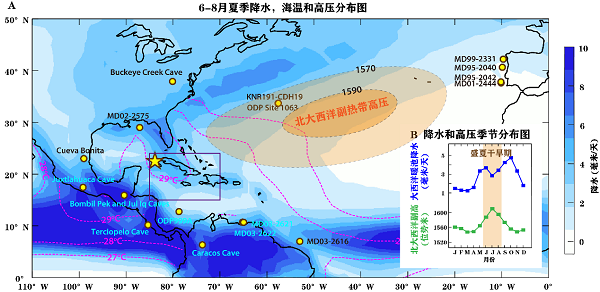
The journal Science Advances published a paper titled North Atlantic Subtropical High forcing of Atlantic Warm Pool hydroclimate variability on millennial to orbital timescales on Nov 29. The study was led by Professor Cheng Hai from Xi'an Jiaotong University's (XJTU) School of Human Settlements and Civil Engineering and Institute of Global Environmental Change, in collaboration with Professor Amos Winter from Indiana State University, Professor Ashish Sinha from California State University, and Professor Sophie Warken from Heidelberg University.
Existing research suggests that increased summer insolation in the Northern Hemisphere is associated with increased tropical rainfall. However, paleoclimate records from Cuban cave stalagmites indicate that the Caribbean region actually became drier during periods of heightened summer insolation.
This study is the first to identify the North Atlantic Subtropical High (NASH) as the key factor controlling the region's aridity – a factor that has long been overlooked. This vast high-pressure system has dominated precipitation variability in the Atlantic Warm Pool (including the Caribbean Sea, Gulf of Mexico, and parts of Central America) over millennial to orbital timescales.
At the orbital scale, classical monsoon zone stalagmite oxygen isotope (δ18O) records show that increased summer insolation correlates with stronger monsoons (lower δ18O). For example, multiple stalagmite δ18O records from China in the Asian monsoon region and Brazil in South America exhibit this pattern.
In contrast, multiple Central American stalagmite δ18O records from the same latitudinal band show the opposite relationship. Stalagmite δ18O records from Colombia, Guatemala, Costa Rica, and Cuba indicate that increased summer insolation corresponds to higher δ18O values in the Atlantic Warm Pool region.
To better understand this observation, the study explains the underlying air-sea coupling mechanisms using modern observational data, reanalysis data, paleoclimate simulations, and paleoclimate reconstructions.
Based on modern data, the study finds that the east-west oscillation of the NASH's western boundary is strongly correlated with the Atlantic Multidecadal Variability (AMV) tripole, influencing Atlantic Warm Pool precipitation and its oxygen isotopes.
When the NASH's western boundary shifts westward, the tropical North Atlantic becomes anomalously cooler, leading to reduced precipitation in the Atlantic Warm Pool and higher precipitation δ18O values. Simulation results show that during periods of maximum solar radiation (precession minima), the NASH intensifies and shifts westward, reducing Atlantic Warm Pool precipitation, and vice versa.
The study highlights the importance of the NASH. Mechanistically, high solar radiation increases the land-sea temperature contrast between the North American continent and the North Atlantic, driving NASH intensification.
Additionally, by comparing land and ocean paleoclimate records, the study finds that periods of high summer insolation often correspond to lower tropical North Atlantic sea surface temperatures, further amplifying the land-sea temperature contrast and strengthening the NASH. This not only significantly reduces precipitation in Cuba, but also suppresses precipitation in the core monsoon regions of Central America, such as Colombia, Guatemala, and Costa Rica.
Another intriguing finding is the orbital-scale amplitude difference in Cuban stalagmite δ18O records before and after 60 ka. By comparing solar radiation amplitudes and tropical Atlantic sea surface temperature amplitudes, the study finds that during 130–60 ka, high solar radiation amplitudes and high sea surface temperature variations led to more pronounced precipitation amplitudes in Cuba. In contrast, during 60–12 ka, low solar radiation and low sea surface temperature variability resulted in more subdued Atlantic Warm Pool precipitation changes.
The study also reveals that when strong land heating coincides with cooler Atlantic Ocean temperatures, it further enhances the westward extension of the high-pressure system, leading to severe and prolonged droughts in the Caribbean.
The two most severe "megadroughts" in the past 129,000 years occurred around 126,000 and 105,000 years ago, coinciding with periods of peak summer insolation and extremely cold Atlantic Ocean temperatures. This drought mechanism is similar to the modern "midsummer drought" affecting the Caribbean region, but past events were more intense and could persist for centuries.