XJTU team proposes innovative approach to selective photocatalysis
The phenomenon of regulating photochemical reactions through single atoms is widespread in nature. However, achieving atomic-level precision in catalytic selectivity regulation within artificial photocatalyst systems remains a major challenge in this field.
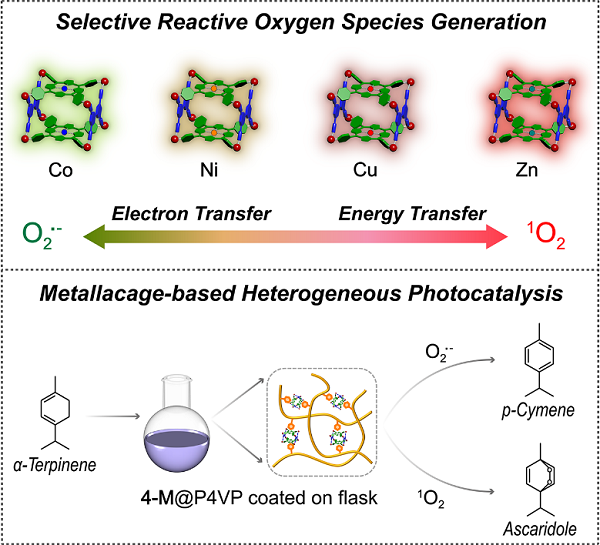
To address this challenge, Professor Zhang Mingming's team from the School of Materials Science and Engineering at Xi'an Jiaotong University (XJTU) proposed regulating the type of central metal atom (Co, Ni, Cu, Zn) in the metalloporphyrin ligands within a metal cage.
By utilizing the differences in d-orbital electron distribution among different metal centers, they precisely modulate the charge transfer process between the ligand and the metal, achieving controllable switching from electron transfer to energy transfer. This enables the directional generation of different reactive oxygen species (ROS) in photocatalytic reactions, effectively realizing selective catalysis.
The Co-porphyrin metal cage, due to the partially filled 3d orbitals of the Co atom, preferentially undergoes the ligand-to-metal charge transfer process, primarily generating superoxide anion radicals. In contrast, the Zn-porphyrin metal cage, with its fully filled 3d orbitals, tends to undergo energy transfer, specifically producing singlet oxygen.
Ni and Cu porphyrin metal cages exhibit dual-component characteristics between these two extremes. This differential generation mechanism of ROS results in significant selectivity differences in the photocatalytic oxidation reaction of α-terpineol, respectively directing the formation of p-cymene or ascaridole.
The research team further constructed a supramolecular network heterogeneous photocatalytic system through secondary coordination interactions between the metal porphyrins and poly(4-vinylpyridine), thus enhancing the catalyst's stability and recyclability.
This study has achieved the single-atom precision regulation of ROS pathways within the metal cage framework, providing innovative insights for designing a new generation of adaptive photocatalytic systems. It holds promise for extension to the green synthesis of more high-value-added chemicals.
This research achievement has been published in the international chemistry journal Angewandte Chemie International Edition under the title Single-Atom-Modulated Reactive Oxygen Species Generation and Network Crosslinking in Porphyrin-Based Metallacages for Selective Photocatalysis and was selected as a hot paper.