XJTU team develops self-repairing encapsulation for perovskite solar devices
Perovskite solar cells, with their high photoelectric conversion efficiency and low manufacturing costs, are emerging as frontrunners in the commercialization of next-generation photovoltaic technologies. However, their inherent stability challenges and potential lead leakage risks hinder large-scale application and sustainable development.
Existing encapsulation materials, primarily adapted from traditional silicon cell technologies, offer basic protection but lack self-healing capabilities. Once cracks form in the encapsulation layer under outdoor conditions, its barrier function is permanently compromised, leading to moisture and oxygen ingress, accelerated performance degradation, and irreversible lead pollution risks.
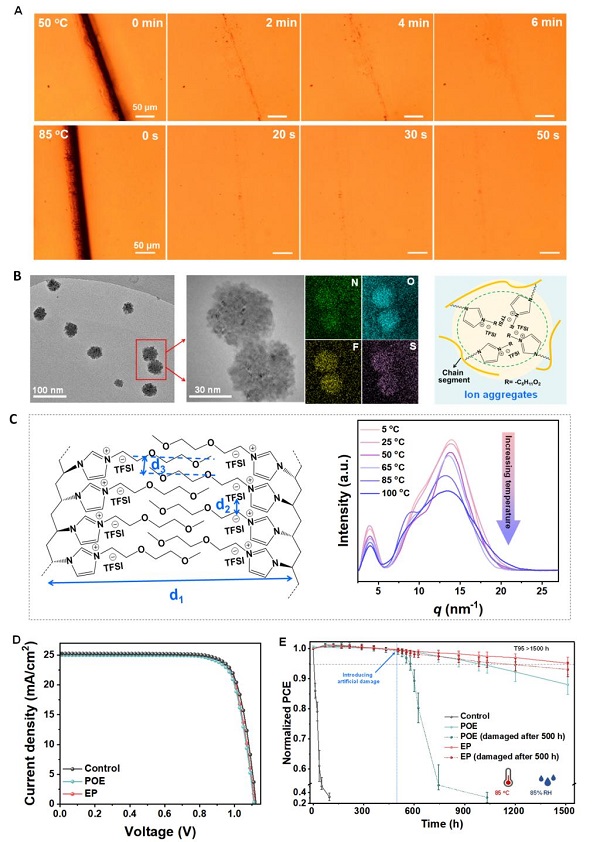
Professor Lu Guanghao's team at Xi'an Jiaotong University (XJTU) has developed a novel polymer encapsulation material featuring dynamic ionic aggregates of alkoxy-polyethylene imidazole bis(trifluoromethanesulfonyl)imide.
The material's design incorporates flexible alkoxy side chains to lower the glass transition temperature, while large-volume, highly delocalized bis(trifluoromethanesulfonyl)imide anions and imidazolium cations form dynamic, reversible ionic aggregates, creating a unique "soft-hard" synergistic structure.
The self-healing capability arises from the thermal responsiveness of these ionic aggregates. When damaged and heated, the electrostatic interactions weaken, causing the ions to dissociate and carry polymer chains toward the crack interface, where they rebond autonomously.
This process is driven by both enthalpy (ΔH < 0) and entropy (ΔS > 0), reducing the system's Gibbs free energy (ΔG < 0) and enabling rapid, spontaneous healing. Experiments show that the encapsulation layer can fully repair cracks in just 6 minutes at 50 C and 50 seconds at 85 C.
The material exhibits outstanding performance, including high transparency, strong adhesion, and excellent water-oxygen barrier properties. More importantly, it achieves over 99 percent lead leakage suppression efficiency under simulated extreme conditions like heavy rain, thanks to the synergistic effect of self-healing physical barriers and chemical adsorption.
Accelerated aging tests demonstrate long-term stability, with encapsulated devices retaining 95.17 percent of initial efficiency after 1,500 hours of damp-heat testing and 93.53 percent after 300 thermal cycles.
This research, published in Science Advances under the title A rapid self-healing polymer mediated by ion aggregates achieves effective encapsulation of sustainable perovskite solar cells, marks a significant advancement in perovskite photovoltaic reliability.
-
XJTU and Hong Kong Polytechnic University achieve breakthrough in energy storage dielectrics
December 18,2025
-
XJTU research team reveals North Atlantic Subtropical High's dominance over tropical hydroclimate
December 16,2025
-
XJTU paper wins Cell Press' 2024 Most Popular China Paper Award
December 14,2025